Taxi in Hamburg: The Cost, and Where the 9km Line Falls
Hamburg's tariff has a built-in reward for long journeys: from the ninth kilometre the rate drops by 70 cents. That makes the run out to Blankenese cheaper than you expect — and three kilometres into the Schanze dearer.

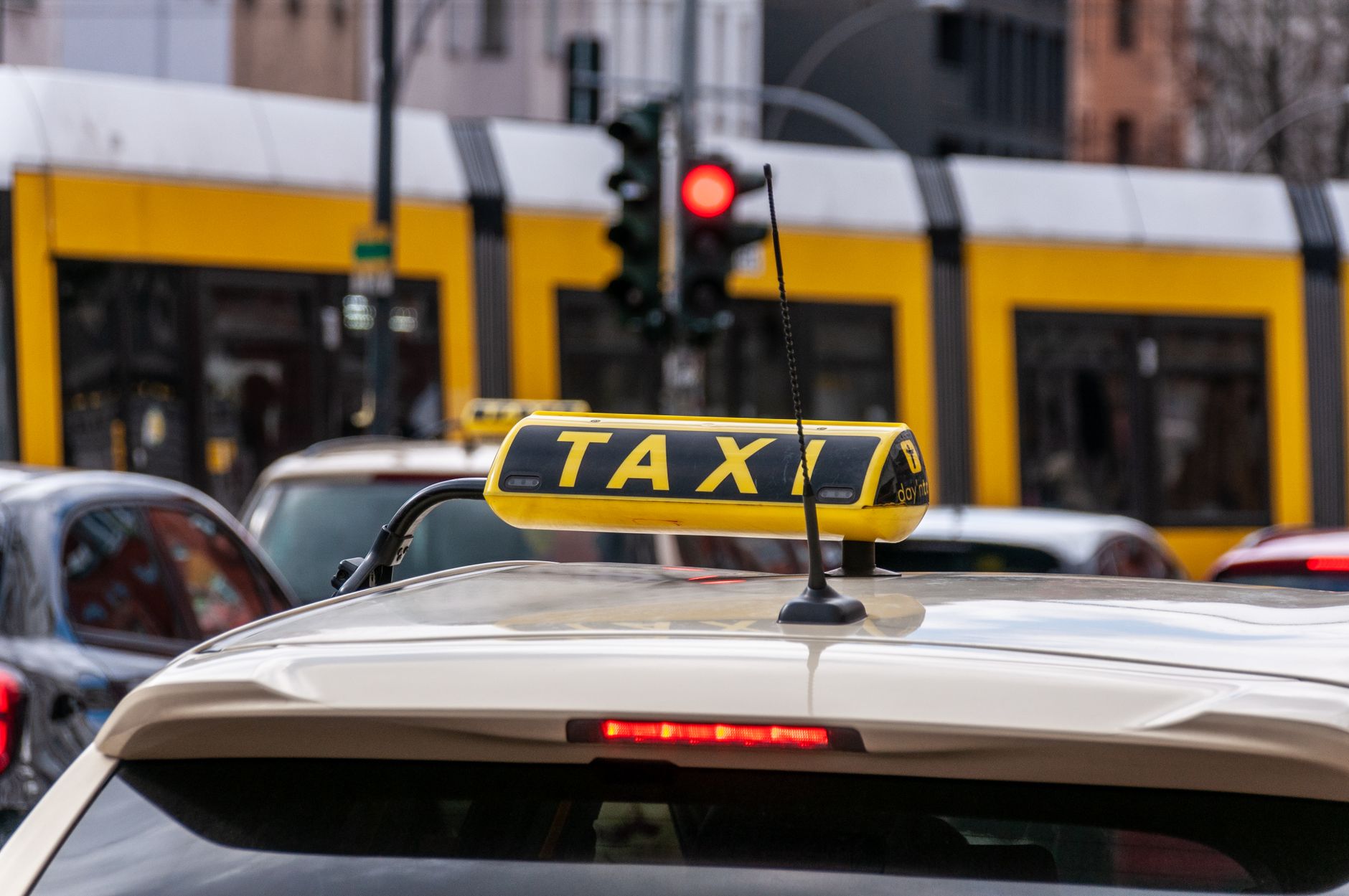
Most German taxi tariffs work on the principle of “further equals dearer, in a straight line”. Hamburg does it differently, and this is the one thing you need to remember: from the ninth kilometre, every further kilometre gets noticeably cheaper.
That sounds like a detail for tariff obsessives. It is not. It decides whether a long journey in Hamburg is an irritation or a reasonable proposition — and the answer is surprisingly often the latter.
The tariff as of 2026
| Item | Price |
|---|---|
| Base fare | €4.50 |
| Kilometres 1 to 9 | €2.70 each |
| From kilometre 9 | €2.00 each |
| Waiting time | around €38.00 an hour |
| Minivan, from the 5th passenger | €8.00 once |
Two things stand out.
First, there is no night surcharge. Three in the morning on a Friday costs what ten on a Tuesday costs. Hamburg abolished the old distinction between peak and off-peak periods — the kilometre rate now sits uniformly at the level that used to apply only at peak times. Night travellers gain from that; daytime travellers pay slightly more than they once did.
Second, waiting time runs in traffic. €38 an hour is around 63 cents a minute, and the meter draws no distinction between “the passenger is getting in” and “we are stationary at the Elbe bridges”. Fifteen minutes in a jam costs you nearly ten euros without covering a metre.
The nine-kilometre line in numbers
Worth working through, so it is clear what we are talking about:
| Distance | Calculation | Fare |
|---|---|---|
| 3 km | €4.50 + 3 × €2.70 | €12.60 |
| 9 km | €4.50 + 9 × €2.70 | €28.80 |
| 15 km | €28.80 + 6 × €2.00 | €40.80 |
| 20 km | €28.80 + 11 × €2.00 | €50.80 |
Without the tiering, 20 kilometres would cost €58.50. The threshold therefore saves you nearly eight euros on that run.
The more revealing figure is the average price per kilometre. Over three kilometres, including the base fare, you pay €4.20 a kilometre. Over twenty, it is €2.54. Proportionally, the short hop is by far the most expensive — which shows up sharply in Hamburg, because the centre is compact and a great many journeys stay under five kilometres.
My practical take: under three kilometres in Hamburg, take the U-Bahn or a bus, unless you have luggage or it is one in the morning. Over ten kilometres the taxi shifts from luxury to defensible transport, particularly with two or three of you.
Where the long runs go
The tiering matters more in Hamburg than in most German cities because the city is spread out. Several typical journeys sit squarely in the cheaper band.
Hauptbahnhof to Blankenese is a good 15 kilometres — a distance where the second tier bites properly.
Hauptbahnhof to Bergedorf is of the same order. Here too you pay the lower rate for most of the journey.
Within the ring — Sternschanze, St. Pauli, Altona, Winterhude, Eppendorf — you will almost always stay under nine kilometres, and the dearer €2.70 rate applies throughout.
The consequence is not especially intuitive: a journey right across the city does not cost twice what a half-length one costs. It costs considerably less than twice.
To the airport: the run where the tiering bites
Hamburg Airport sits in the north of the city, in Fuhlsbüttel. Depending where you start, roughly eight to fifteen kilometres separate you from the terminal — precisely the band in which the nine-kilometre line starts to matter.
Work it out for yourself before deciding. On the tariff above, a 10-kilometre run costs about €30.80 (€4.50 + 9 × €2.70 + 1 × €2.00), and a 14-kilometre run about €38.80. On top comes whatever waiting time the traffic generates — and on the Alsterkrugchaussee in the morning that tends to add up.
The comparison with the S1, which serves the airport directly, is therefore clear: travelling alone, the train is considerably cheaper. With three people and luggage the calculation tips, because the fare does not rise with the headcount and you avoid the change.
One note on the return: after a late landing the rank outside the terminal is generally occupied, but waits can lengthen at the margins of the day. If your flight arrives after 11pm, pre-booking at a fixed price is the calmer option — more on which next.
Fixed prices, available since 2025
Since 1 February 2025 you have been able to book pre-ordered journeys in Hamburg at a fixed price. The price is set in advance and does not move, whatever happens en route.
For a booking by app or telephone that is a genuine improvement — for a reason that has nothing to do with saving money: you stop carrying the congestion risk. At 63 cents a minute of waiting time, in a city with the Elbe tunnel and bridge traffic, that is a real argument.
On top of that, a price corridor was trialled from 15 October 2025, under which fixed prices may deviate from the metered tariff by up to 20 per cent in either direction. That trial was initially set to run to 14 June 2026. Whether and in what form it continues is worth checking when you book; it was expressly framed as an experiment.
What to take from it: a fixed price is not automatically cheaper than the meter. It is predictable. If the fixed price quoted sits well above your own calculation, take the meter — on a clear run you will nearly always come out ahead.
Minivan taxis: the €8 threshold
From the fifth passenger a minivan taxi becomes necessary, and that carries a one-off €8.00. One-off means regardless of distance.
With five of you that is an excellent deal. Spread over a 15-kilometre journey it works out at about ten euros each — less than two single HVV tickets would cost. With five people, the taxi is simply the cheaper mode in Hamburg as soon as the distance amounts to anything.
One practical note: minivans do not sit at every rank in any number. If there are five or six of you, book ahead — turning up at the Hauptbahnhof and hoping can take a while.
What costs nothing extra in Hamburg
The list of surcharges is short, which is as it should be. Luggage is free. A dog is free. There is no night surcharge, no weekend surcharge and no public holiday surcharge.
The only regular supplement is the minivan one. If anyone tries to charge you something else, ask to see the tariff notice — it has to be displayed in the vehicle.
On payment: card acceptance in Hamburg taxis is largely standard but not guaranteed. Ask as you get in, not as you get out. That is the second that spares you an awkward conversation — as in any other city, see taxis in Berlin: what the journey costs.
Taxi or HVV?
Honestly reckoned: for one person over a short distance, the HVV is hard to beat in Hamburg. The network is dense, the U-Bahn runs through the night at weekends, and the centre is small.
The taxi wins in three situations. Three or more of you, because the fare does not rise with the headcount. With luggage, because changing trains with suitcases in Hamburg’s stations is rarely quick. And on long runs to the outer districts, because the second tier applies there while the rail journey simultaneously gets longer.
One place where the train clearly beats the taxi is Hanover; the sums are under Hannover Airport into town.
How the Uber app price compares with this taxi tariff, surge pricing included, is under Uber prices in Germany.
If you specifically need the journey to and from the airport, with the S-Bahn, night bus and app alternatives compared, that’s under airport transfer Hamburg.
How the tariff looks in a smaller Hanseatic city with its own ferry port is covered under taxi fares in Lübeck.
All amounts reflect the position in 2026. Taxi tariffs are set by the city and adjusted regularly, and Hamburg has changed more of its system in recent years than most other cities — fixed prices, price corridors, the abolition of time bands. What remains is the single number that governs your fare: kilometre nine. More cities are covered under Cities, and the underlying logic under Taxi & Fares.
Keep reading
Taxi & Fares
Taxi Fares in Germany: Why Every City Sets Its Own Price
Taxi fares in Germany: who sets the prices, how a fare is built up, and why the base fare in Berlin and Munich differs by nearly two euros.
Jonas Reinhardt14 August 2026
Taxi & Fares
Taxi Fares on Lanzarote: The Tariff That Actually Applies at the Airport
Lanzarote taxi fares in 2026: a €3.85 minimum, €1.35 per kilometre, a €2.10 airport supplement — and why Arrecife's town tariff has no say at the terminal.
Jonas Reinhardt17 September 2026
Taxi & Fares
Taxi Düsseldorf: What a Ride Costs and Where the €25 Fixed Fare Applies
Düsseldorf taxi fares 2026: a €5 base fare, €2.70 per kilometre, €43 an hour waiting, a €2 airport supplement and a fixed price between the airport and the trade fair – with worked fares across the city.
Jonas Reinhardt25 September 2026
Taxi & Fares
Taxi Dresden: Fares, Fixed Airport Prices and the 2027 Rise
Dresden taxi fares 2026: a €4.90 base fare, €3.20 per km for the first four kilometres, then €2.60 and €2.40, a fixed €48 from the airport to the Hauptbahnhof – with worked fares to the Frauenkirche and the second step due in January 2027.
Jonas Reinhardt25 September 2026
Taxi & Fares
Taxi Cologne: What a Ride Costs and Why the Tariff Reaches Düsseldorf
Cologne taxi fares 2026: a €4.90 base fare, a flat €2.90 per kilometre, 60 cents a minute waiting – with worked fares to the trade fair, Cologne Bonn Airport and the rise already set for March 2027.
Jonas Reinhardt25 September 2026